Site & Datacenter
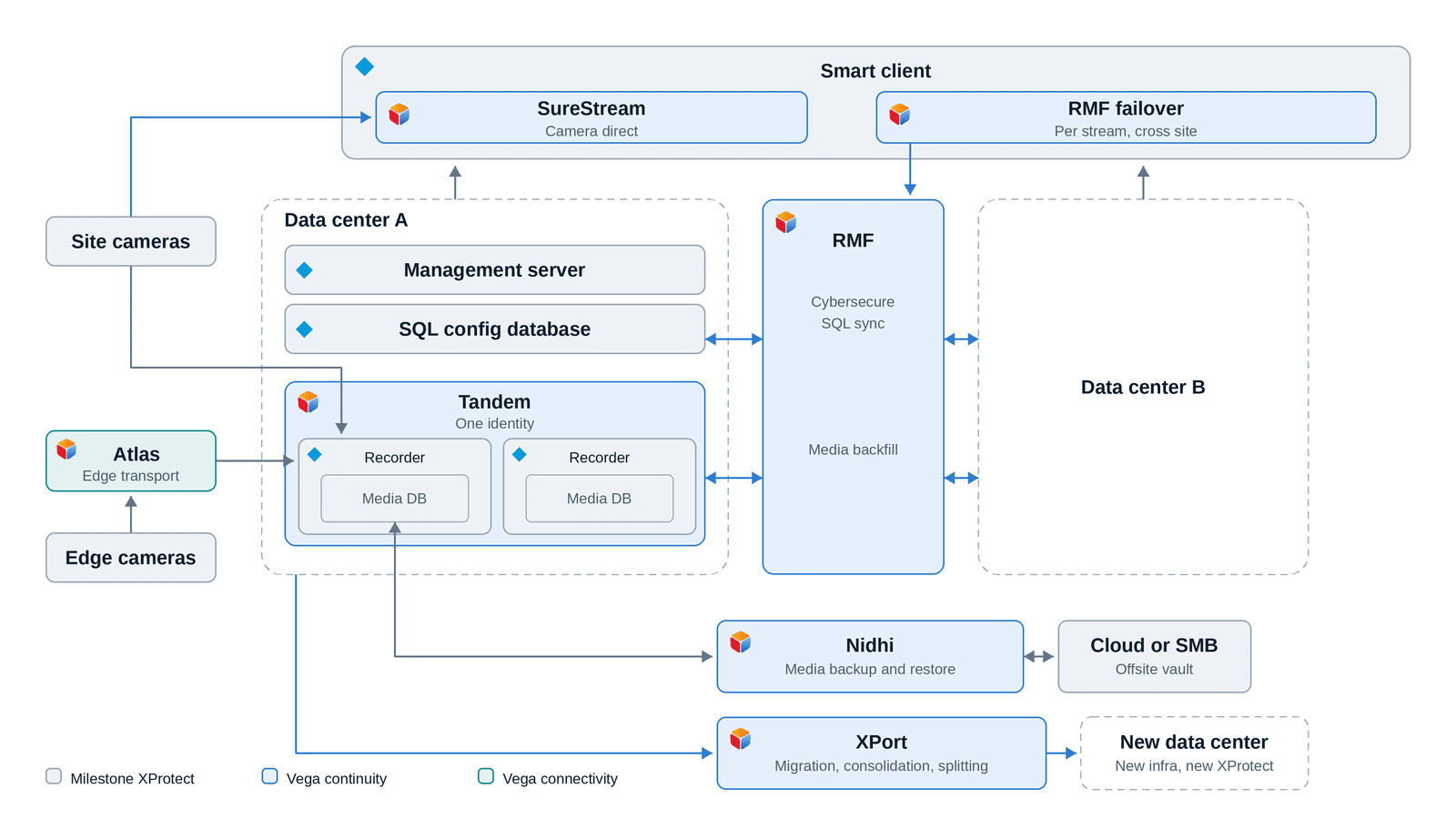
RMFCybersecure redundancy across active-active sites. Object-level synchronization isolates data centers so malware cannot spread.
Loading . . .
Product Guide
Every Vega product is built for a specific point of failure, or a specific project. Here's which one fits, where it fits, and how they work together to keep critical video online.
Each product is built for a specific point of failure, or a specific project. Here's which one fits, and when.
Site & Datacenter
RMFCybersecure redundancy across active-active sites. Object-level synchronization isolates data centers so malware cannot spread.
Milestone XProtect·Perpetual, per device
Recording Server
TandemRecorder-only HA, where failover stays invisible to PSIM, access control, and analytics. Two recorders, one identity.
Milestone XProtect·Perpetual, per recorder pair
Operator & Client
SureStreamKeep the video live on the operators' screen during a catastrophic VMS infrastructure failure. Stream directly from cameras to clients.
Milestone XProtect·Perpetual, per device
Retention & Backup
NidhiAutomated media backup and restoration to the cloud or SMB for disaster recovery.
Milestone XProtect·Annual, per recorder
Migration & Consolidation
XPortMove, merge, or split XProtect deployments. Simplify upgrades. Automate life-cycle infrastructure processes and save time and money.
Milestone XProtect·Annual, per recorder
Edge & Transport
AtlasMake cameras on vehicles and remote sites appear to the SOC like local LAN cameras. Save connectivity costs through Edge AI. Automatically adapt streams to bandwidth.
VMS Agnostic·Per-device subscription
Two redundancy products
Both deliver active-active redundancy. The difference is the layer they protect.
Cybersecure redundancy across sites
Transparent recorder HA within a site
Side by side
| RMF | Tandem | |
|---|---|---|
| Layer protected | Recorders, management server, SQL, whole site | Recording servers only |
| Cybersecurity | Object sync stops malware; isolated data centers | Not a cyber control; mirrors the pair |
| Failover | Client-side, stream-level | Server-side, single logical identity |
| Topology | Symmetric, Asymmetric — any camera to any recorder | Strict 1:1 recorder pair |
| Storage retention & Streaming Profiles | Independent — primary and secondary can differ | Identical on both recorders |
| Reach | Across subnets and dispersed sites | Within one XProtect deployment |
| Licensing | Per device | Per recorder pair |
| Client footprint | RMF Smart Client plugin | None — standard Smart Client |
| Third-party integrations | Redundancy exposed through REST API | Transparent — nothing to change |
| Both sites serving | Yes | Standby serves only on failover |
Common to both: they run on every XProtect variant — including editions without native Milestone failover — and each keeps two recorders capturing continuously, so both eliminate the recording gap that standard XProtect failover leaves behind. Those are shared strengths, not differentiators — the difference is everything above.
They work at different layers, so they can run together. Deploy Tandem inside a site for recorder-level HA — especially where third-party integrations are dense — and RMF across isolated, dispersed data centers for cybersecure, asymmetric, device-level redundancy that also covers the management server and SQL. Tandem protects the recorder identity; RMF protects the site and the cyber boundary.
